$25.00 a foot installed, every day.

$25.00 a foot installed, every day.

The product, before the sales pitch

Permanent lighting: what it is, and what goes on your house

A run of RGBW LEDs sits inside a channel painted to your own trim, the channel mounts up under the eave, and the wiring is hidden on install day. It is a fixture on the house rather than a decoration on it, so it goes up once and stays there, and you run it from your phone every night of the year.

The every day price is $25.00 a foot installed, year round. The Sentinel controller is $345.

Five questions answered in full, then the system part by part: the channel, the LEDs, the wiring, the Sentinel controller, and the five years that cover all of it.

Claim A Free Mockup

Last updated

RGBWRed, green, blue and a true warm white out of the same run
1.58Watts a foot, at 4 hours a night
5 yearWarranty on everything, labor included
UL 2108Certified, certificate on request

Definition

What is permanent lighting?

Permanent lighting is a fixture on the house rather than a decoration on it. A run of RGBW LED pucks sits inside a channel painted to a paint ID measured off your own trim, the channel mounts up under the eave, and the wiring is hidden on install day. It goes up once and stays there, and that is the whole of the difference.

Everything else follows from it staying there. No ladder in November and none in January, no box in the garage, and no take-down deadline to meet, because nothing comes down. The lights are run from your phone instead: you pick a color and a movement, save it as a scene, and put the scene on a schedule. What is on the front of the house in daylight is a single line the color of the board it is fixed to.
The rest of the questions people ask before they buy

Daylight

What does it look like in the daytime?

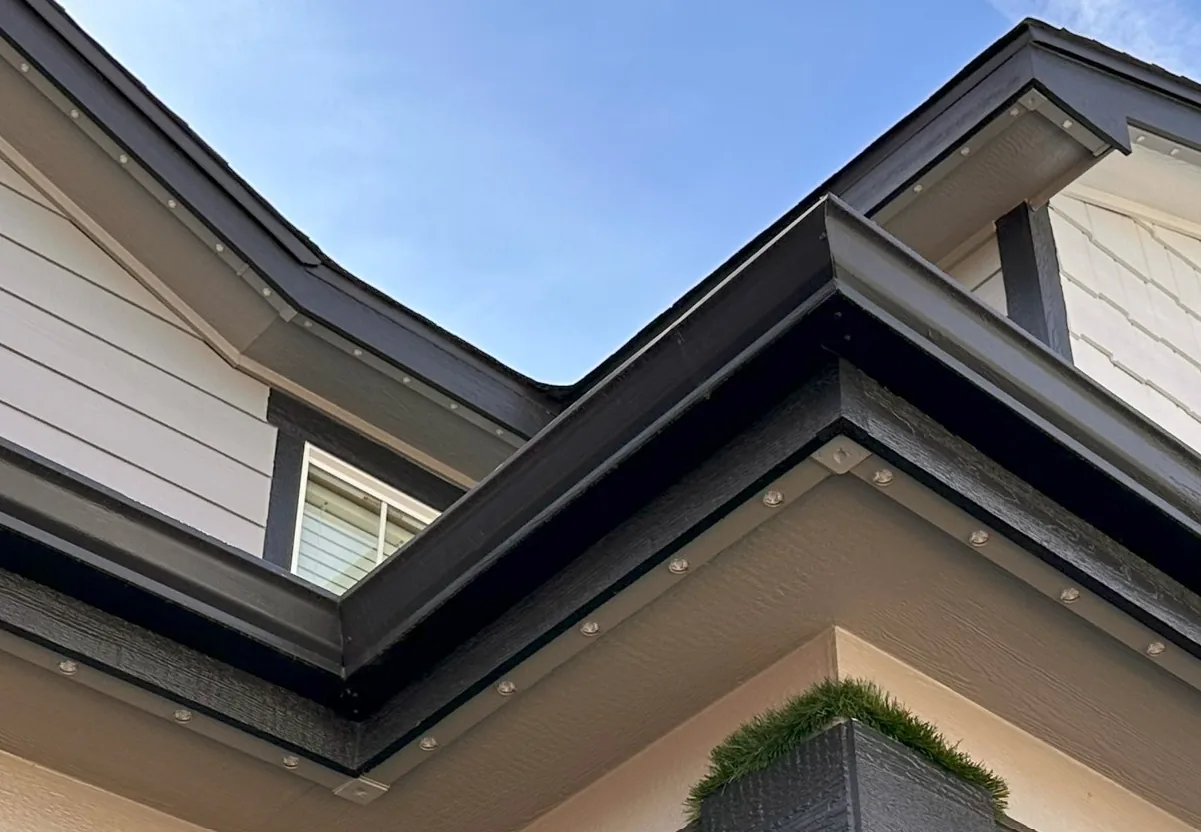
It reads as trim, because it is trim colored and it sits where trim sits. The channel goes up under the eave rather than out on the open roof, and its color is a Sherwin-Williams paint ID measured off your own fascia rather than a catalog white, so at noon what a passer-by sees is a line the same color as the board it is fixed to.

Where it sits does more than hide it. Tucked up behind the fascia, the lenses are not in the line of fire the way a roof mounted fixture's are, which is why hail has never damaged an installed run of ours across several Front Range seasons. The corner connectors are printed in the same color as the channel, so a run turns a corner as one continuous line rather than a row of white joints.

Color matched lighting channel mounted flush under a soffit, photographed in daylight
Noon, Firestone. The channel is painted to the soffit it is fixed under, which is why there is nothing to pick out from the street.

What Front Range weather does to a run

The rest of the year

Can I use it outside the holidays?

Yes, and that is most of what it does. The W in RGBW is a true warm white, so the ordinary setting is warm white down lighting on the front of the house, and the color is there for the nights you want it. Holidays are a handful of scenes on a system that is lit the rest of the time.

A look is saved as a scene, and a scene goes on a schedule, so the house can come on at sunset, dim at a set hour and go off again with nobody touching it. Team colors on game day, warm white through the week, and whatever December needs, all out of the same run and the same controller. The alternative is a crew on a ladder twice a season for a display that is only up for part of the winter.

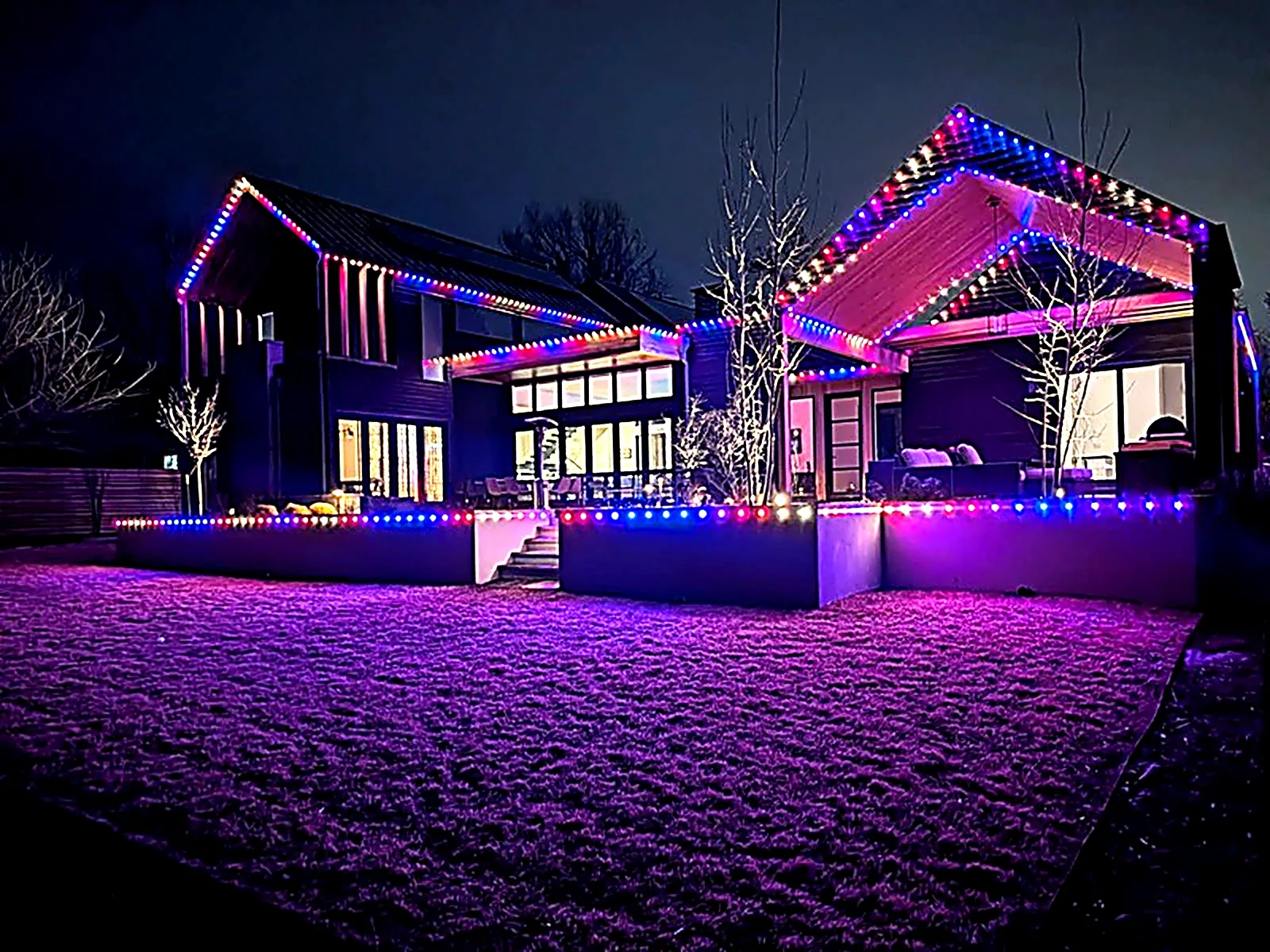
A Front Range home lit at dusk in RGBW color
Dusk, running color. The same run sits at warm white the rest of the week.

Against a kit

How is it different from the lights I can buy online?

A kit is parts in a box, and this is a system measured, painted and fitted to one house with the labor inside the warranty. Three of the differences never appear on a parts list: the channel is painted to a paint ID read off your own trim, the controller cuts the power to the LEDs when the lights are off instead of only turning them off in software, and the five year cover runs to the work as well as the hardware.

Ask whoever is selling you a system the question we would want asked of ours: when the lights are off, is the power to the LEDs actually cut? Ours disconnects the LED load through a solid state relay and sits at 0.003 watts standby, less than an LED night light. A system that is off in software only stays energized at full standby while the house looks dark, and it spends its rated LED hours doing it. The color match is the other thing a box cannot ship, because the paint ID is measured, the channel is sprayed in our own five station booth before it leaves, and the connectors are printed to match.

Whether it works out cheaper to do it yourself LED software setup, in the knowledge base

Ownership

Who owns the system, and what happens if I sell the house?

You own it outright, and it stays on the house. There is no lease and no monthly fee to pass on, and no cloud account holding your scenes for somebody to transfer, because the scenes and the schedule are held on the Sentinel controller mounted at the property. When the house changes hands the lighting goes with it.

That is a consequence of how the controller is built rather than a policy we could change later. Nothing about the system depends on an account staying open, so there is no app fee, nothing to log out of, and nothing to hand over at closing beyond the house itself. Financing through Wisetack, with 0% options, is a loan against a purchase rather than a rental, so the system is yours from the day it goes up.

Part by part

What actually goes on the house.

Four things, fitted in this order, and priced as one installed rate per foot with the controller added once.

The channel

A Sherwin-Williams reader goes on your fascia and returns the exact paint ID. The channel is sprayed that color in our own five station booth, in Sherwin-Williams Direct to Metal, which Sherwin-Williams warrants for 20 years, before it reaches the site.

Some installers ship white channel and hope you do not look up.

The LEDs

RGBW pucks sit about 10 inches apart inside the channel at 1.3 watts each, which is 1.58 watts a foot.

Red, green, blue and a true warm white come out of the same run, so the everyday setting and the color both live in one system.

The wiring and the corners

The wiring is hidden on install day, and the corner connectors are printed to match the channel so the run turns a corner as one line.

The crew is on the roof one to three days, depending on how much there is and whether you are doing the front only or the full package with porches and patios, and the yard is clean when they go.

The controller

One Sentinel controller to a system at $345, mounted out of sight and wired in on install day.

It is the only line on the quote that is not priced per foot.

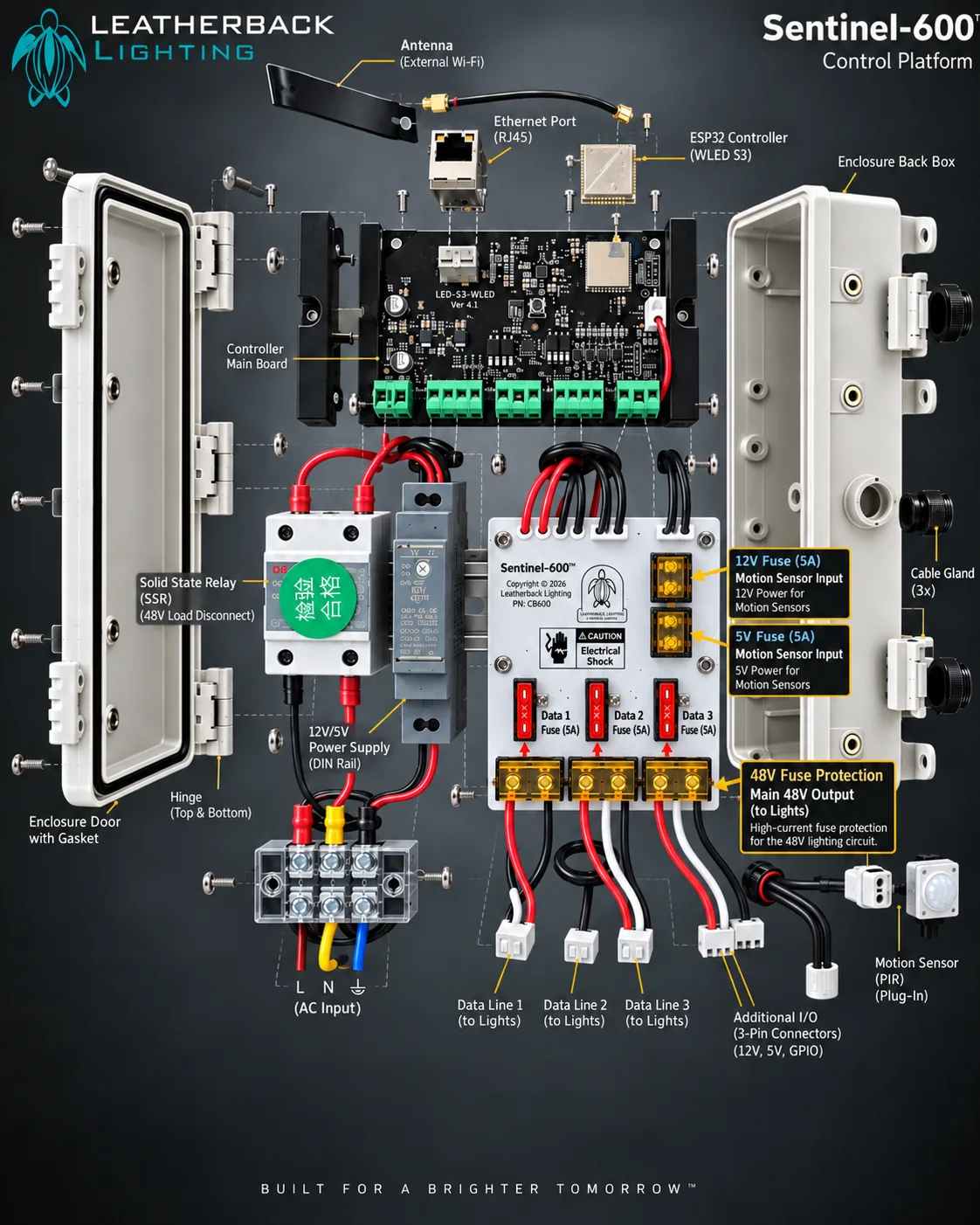
Exploded diagram of the Sentinel 600 control platform showing fused components, gasketed enclosure and solid state relay
The Sentinel-600 control platform, part CB600, shown exploded: fused components, a gasketed enclosure, and the relay that disconnects the LED load.

The hardware that runs it

What the Sentinel controller does.

One piece of hardware, mounted out of sight and wired into the system on install day. Three things it does that change how the system behaves for as long as you own it.

It is built to sit outside

Every component inside it is individually fused, and the enclosure is gasketed and rated for outdoor mounting. It carries the same five year cover as the rest of the system.

It genuinely switches off

A solid state relay disconnects the 48V load when the lights are off, and the controller sits at 0.003 watts standby, less than an LED night light. That is the difference between a system that is off and one that only looks off.

It holds your scenes, not an account

Scenes and schedules are stored on the controller rather than in a cloud account, which is why there is no app fee and nothing to sign up for. It is yours outright and it transfers with the house.

No account, no fee

Scenes on your phone, and nothing to sign up for.

Pick a color, pick a movement, save it as a scene. A scene goes on a schedule, so the front of the house can come on at sunset, dim at a set hour and go off again with nobody touching it.

The schedule and the scenes live on the controller at your house, so there is no cloud account to open and no app fee sitting on top of a system you already own. Your first scenes are set up with you before the crew leaves on install day.

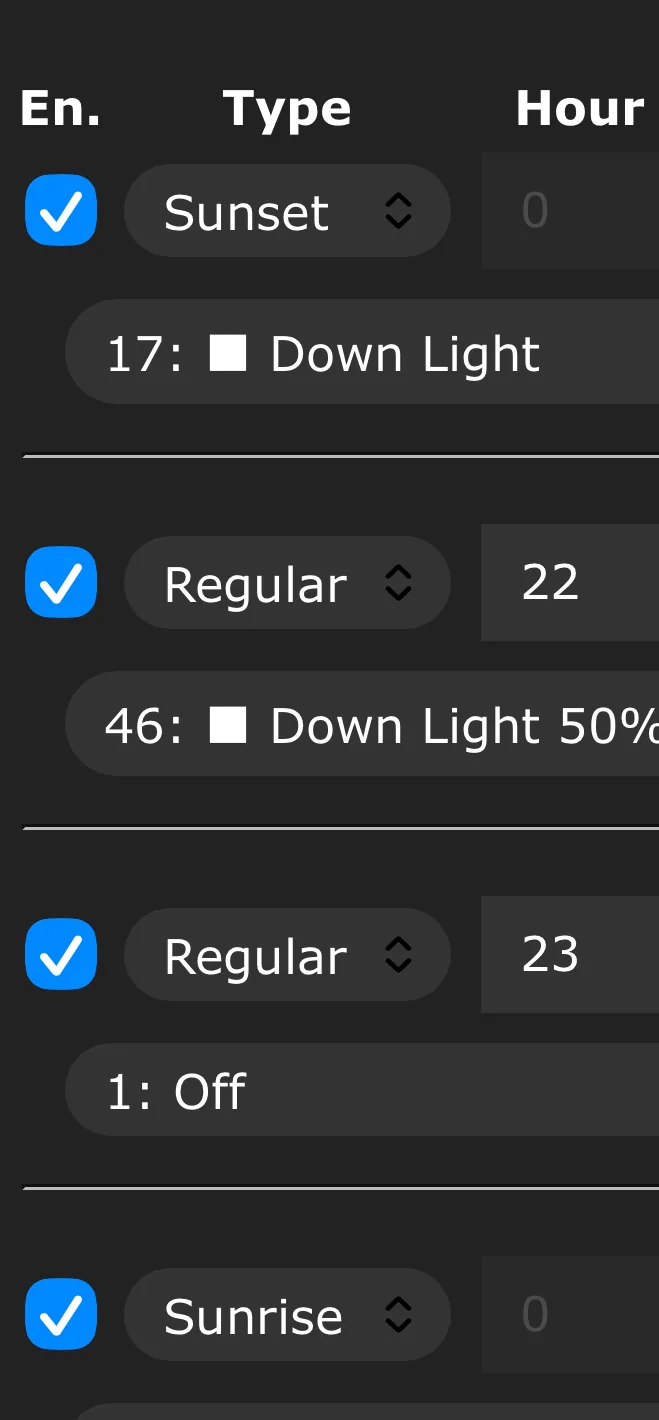
The scheduling screen of the lighting app showing sunset, dim and off times
A schedule held on the controller: on at sunset, dimmed to 50% at 22:00, off at 23:00, and off again at sunrise.

What it draws

What the system costs to run.

A run draws 1.58 watts a foot and is scheduled for about 4 hours a night, so the electricity is a small number rather than a hidden one. The LEDs are rated at 100,000 hours, which at that usage is 68 years.

  • 1.58Watts a foot: pucks about 10 inches apart at 1.3 watts each
  • 4Hours a night, the average a system is scheduled to run
  • 68Years of LED life at that usage, from a 100,000 hour rating

The bigger number is what a system draws when it looks off, which is where the controller earns its place. The cost page carries the full arithmetic, a twenty year chart and the electricity rate it is built on.

The full running cost, and the twenty year chart

What it costs

One installed rate, per foot of roofline.

$25.00 a foot installed, year round.

That rate covers the channel, the RGBW LEDs, the color match and the labor. The Sentinel controller, our own smart controller, is $345 on top, and there is no minimum job. The written quote from the free on-site visit stays good for 15 days whether you buy or not.

See it drawn on your own house first.

Free on-site visit, about 45 minutes. We measure the roofline, read your trim color, and you keep the mockup and the written quote whether you buy or not.

Claim A Free Mockup

(720) 986-9449